

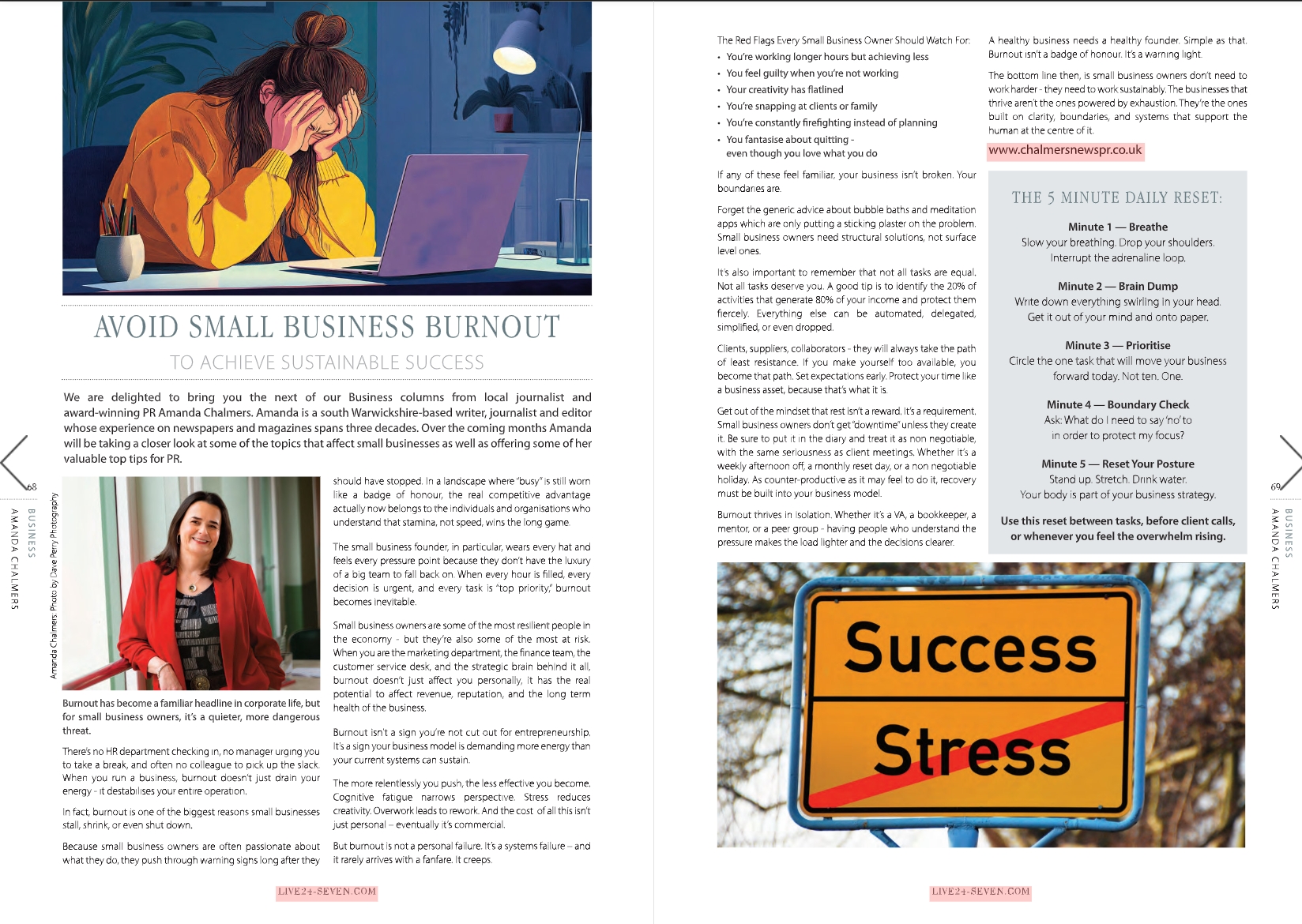
Burnout has become a familiar headline in corporate life, but for small business owners, it’s a quieter, more dangerous threat.
There’s no HR department checking in, no manager urging you to take a break, and often no colleague to pick up the slack. When you run a business, burnout doesn’t just drain your energy – it destabilises your entire operation.
In fact, burnout is one of the biggest reasons small businesses stall, shrink, or even shut down.
Because small business owners are often passionate about what they do, they push through warning signs long after they should have stopped. In a landscape where “busy” is still worn like a badge of honour, the real competitive advantage actually now belongs to the individuals and organisations who understand that stamina, not speed, wins the long game.
The small business founder, in particular, wears every hat and feels every pressure point because they don’t have the luxury of a big team to fall back on. When every hour is filled, every decision is urgent, and every task is “top priority,” burnout becomes inevitable.

Small business owners are some of the most resilient people in the economy – but they’re also some of the most at risk. When you are the marketing department, the finance team, the customer service desk, and the strategic brain behind it all, burnout doesn’t just affect you personally, it has the real potential to affect revenue, reputation, and the long‑term health of the business.
Burnout isn’t a sign you’re not cut out for entrepreneurship. It’s a sign your business model is demanding more energy than your current systems can sustain.
The more relentlessly you push, the less effective you become. Cognitive fatigue narrows perspective. Stress reduces creativity. Overwork leads to rework. And the cost of all this isn’t just personal – eventually it’s commercial.
But burnout is not a personal failure. It’s a systems failure – and it rarely arrives with a fanfare. It creeps.
The Red Flags Every Small Business Owner Should Watch For:
- You’re working longer hours but achieving less
- You feel guilty when you’re not working
- Your creativity has flatlined
- You’re snapping at clients or family
- You’re constantly firefighting instead of planning
- You fantasise about quitting – even though you love what you do
If any of these feel familiar, your business isn’t broken. Your boundaries are.
Forget the generic advice about bubble baths and meditation apps which are only putting a sticking plaster on the problem. Small business owners need structural solutions, not surface‑level ones.
It’s also important to remember that not all tasks are equal. Not all tasks deserve you. A good tip is to identify the 20% of activities that generate 80% of your income and protect them fiercely. Everything else can be automated, delegated, simplified, or even dropped.
Clients, suppliers, collaborators – they will always take the path of least resistance. If you make yourself too available, you become that path. Set expectations early. Protect your time like a business asset, because that’s what it is.
Get out of the mindset that rest isn’t a reward. It’s a requirement. Small business owners don’t get “downtime” unless they create it. Be sure to put it in the diary and treat it as non‑negotiable, with the same seriousness as client meetings. Whether it’s a weekly afternoon off, a monthly reset day, or a non‑negotiable holiday. As counter-productive as it may feel to do it, recovery must be built into your business model.
Burnout thrives in isolation. Whether it’s a VA, a bookkeeper, a mentor, or a peer group – having people who understand the pressure makes the load lighter and the decisions clearer.
A healthy business needs a healthy founder. Simple as that. Burnout isn’t a badge of honour. It’s a warning light.
The bottom line then, is small business owners don’t need to work harder – they need to work sustainably. The businesses that thrive aren’t the ones powered by exhaustion. They’re the ones built on clarity, boundaries, and systems that support the human at the centre of it.

The 5‑Minute Daily Reset
Minute 1 — Breathe
Slow your breathing. Drop your shoulders. Interrupt the adrenaline loop.
Minute 2 — Brain Dump
Write down everything swirling in your head. Get it out of your mind and onto paper.
Minute 3 — Prioritise
Circle the one task that will move your business forward today. Not ten. One.
Minute 4 — Boundary Check
Ask: What do I need to say ‘no’ to in order to protect my focus?
Minute 5 — Reset Your Posture
Stand up. Stretch. Drink water. Your body is part of your business strategy.
Use this reset between tasks, before client calls, or whenever you feel the overwhelm rising.


