Lawyer-turned-founder builds digital platform to celebrate disability and carer communities on behalf of her son

Lawyer-turned-founder builds digital platform to celebrate disability and carer communities on behalf of her son

Blue Badgers, Stephanie Jackson, disability

An entrepreneur and mum of three walked away from a successful corporate career to build a new venture inspired by her experience as a carer for her son.

Stephanie Jackson, from Solihull, has established Blue Badgers, an interactive online platform and app offering rewards and connection for both people with disability and their carers.

The mission is rooted in over thirteen years of lived experience with her eldest son, Ben. As one of only 40 people globally with You-Hoover-Fong Syndrome – a rare genetic condition – Ben’s ability to move, learn, and see the world is profoundly limited. For Stephanie, this meant becoming a lifelong carer as well as a new mum.

Blue Badgers, Stephanie Jackson, disability

But it was some eight years after Ben was born – arriving at full term weighing just 3lbs – that Stephanie and her husband, Mike, finally received a diagnosis. Until that moment, they were one of hundreds of families navigating the limbo of Syndromes Without a Name.

Stephanie reflects that getting those answers was a profound relief, an outcome that wouldn’t have been possible without the 100,000 Genomes Project given how incredibly rare the condition is.

However, the timing was a true test; they were expecting their third child when the news arrived, adding another layer to the “ups and downs” parents face in this unseen world.

Blue Badgers, Stephanie Jackson, disability

Ultimately, Ben’s journey has contributed to a much larger picture. By using the family’s data to develop a new clinical test, geneticists have turned their experience into a permanent advancement in medical science. Ben is now part of a small pool of individuals helping to map the human genome, providing a deeper understanding that will directly benefit other families in the years to come.

She added: “When a child has complex needs and can’t care for themselves, there’s no such thing as an ‘off’ moment. Being a mum is incredibly rewarding, but some days are emotionally exhausting. Life can feel both isolating and relentlessly hectic.”

Across the UK, Stephanie is just one of a silent army of 10.6 million people providing the unpaid care that keeps families and communities running. Many carers balance this work alongside careers, with a significant number providing tens of hours of support each week, including more than 1.5 million people providing 50 or more hours of care each week.  It is a labour of love that carries no protection against burnout.

Blue Badgers, Stephanie Jackson, disability

“This isn’t just a family duty; it is the invisible infrastructure of our health system.” Stephanie explains.

“Without these millions of hands, the social care sector would simply collapse. I reached a point where I needed to channel my professional skills into changing how this community is seen and valued.”

Founded on Ben’s birthday, Blue Badgers seeks to fill a significant gap in the support landscape. While discount schemes exist for students and professional, paid carers, there has been no equivalent of – or recognition for – the millions of unpaid parents, siblings, and friends whose roles are often taken for granted.

She said: “The disability and carer community holds extraordinary strength, resilience and talent. We need to celebrate our differences, show appreciation and share the joy. We want to say thank you by connecting them with businesses that truly value their contribution.”

Blue Badgers, Stephanie Jackson, disability

“Why shouldn’t a carer get a discounted ticket on a respite day? Caring isn’t a part-time role – that role exists 24/7, regardless of whether you are currently standing next to the person you care for.  Unpaid carers give extraordinary amounts of time, energy and compassion without recognition or reward.

Beyond rewards, Blue Badgers is designed with community at its heart. The app features an interactive map, which lets members share and discover accessible, member-friendly businesses and venues tailored to different needs.

The goal is to turn the often-stressful task of planning a day out into something simple, fun, and enjoyable. For just £4.99 a year, members gain access to a movement that prioritises hassle-free fun.

Ultimately, Stephanie, 43, is building more than an app; she is building a community to combat the bleak tone often associated with disability resources.

Blue Badgers, Stephanie Jackson, disability

“Caring can be a very lonely experience, and the energy it takes just to get information or have your voice heard is exhausting,” she says. “I want Blue Badgers to be purposely joyful and celebratory.  The response has been overwhelming – businesses are eager to learn, and families are thrilled to finally have a platform focused on them.”

Reflecting on her journey, Stephanie notes that the seeds for Blue Badgers were sown long ago before Ben came along – volunteering for inclusive residential holidays that bring together disabled and non-disabled children and young people to break down social barriers through adventure and play.

“I loved Birmingham PHAB Camps and my husband Mike came with me on some of those camps too. Looking back, it’s almost like I was always meant to do this.”

The Blue Badgers app is available to download on Google Play now with the iOS version to follow soon.


AMANDA’S MISSIVES: How to beat imposter syndrome!

AMANDA’S MISSIVES: How to beat imposter syndrome!

For many small business owners, the biggest barrier to growth isn’t funding, competition, or market conditions – it’s the quiet, persistent voice insisting you’re not “legitimate” enough.

The term ‘Imposter Syndrome’ was first coined by psychologists Pauline Clance and Suzanne Imes in 1978. They wrote a paper called ‘The Imposter Phenomenon of High-Achieving Women,’ which was later shortened to the far more catchy “imposter syndrome” we use today.

Running a small business means constantly stepping into new territory: pricing, marketing, finance, leadership, creative direction, customer experience. There’s no handbook, no manager validating your progress, and no guaranteed path. That uncertainty can trigger the irrational belief that you’re “making it up as you go along” or that others are more qualified.

But far from being a ‘fraud,’ understanding these pressures helps you see that imposter syndrome is a disconnect between reality and perception – and, frankly, just a normal response to an extraordinary challenge.

Overcoming imposter syndrome as a small business owner starts with recognising that the doubt you feel is not a reflection of your ability, but in fact a by‑product of building something that matters.

It’s important to remember that expertise isn’t perfection – it’s progress, experience, and the ability to solve problems. Your customers don’t need you to know everything, they need you to know more than they do and to care deeply about the outcome.

And if you’re reading this, that’s clearly already true!

Small business founders carry every role, every decision, every risk – which makes the internal pressure louder than it is for most people. Even the most successful founders occasionally feel the same way. This is why peer conversations are healthy, they can normalise the experience and reduce that sense of isolation.

Unlike employees in larger organisations, small business owners operate without the safety net of a team, a manager, or a clear roadmap.

But it’s all too easy to fall into the trap of comparing yourself with your competitors. Don’t forget that they have these teams, budgets and infrastructure behind them. You’re one person, not a corporation. Instead of aiming for fast and flawless execution, it’s absolutely fine to aim for consistent steady improvement. Progress, not perfection, is the metric that matters. A helpful mindset shift is: “Done with care is better than perfect but unfinished.”

Your impact matters more than your job title, qualifications, or follower count. If your work helps someone, solves a problem, or brings joy, you are not an imposter – you are delivering value.

Entrepreneurs often skip straight to the next challenge without acknowledging progress. Whereas celebrating small wins can build momentum and reinforce your capability. You are all too well aware that the stakes are high when your business is your livelihood. Every decision feels amplified – and without performance reviews or promotions, progress can feel invisible. Yet this doesn’t stop your work being open to the public’s scrutiny.

Creating a portfolio space for testimonials, positive messages, press mentions, photos of your work and milestones will go a long way to helping with this. As well as positive marketing, it becomes a powerful antidote to self‑doubt, especially on those difficult days.

At the end of the day, it’s the fact that you care, reflect, and strive to improve which is evidence of competence – not inadequacy. So when someone compliments your work, resist the instinct to minimise it. (It’s often a default for those of us with imposter syndrome.)  A simple “Thank you — I’m proud of it” reinforces a healthier narrative.

Always remember, whatever your size and bottom line – your business exists because you built it. Your clients choose you because you deliver. Your growth is happening because you are capable.

Imposter syndrome doesn’t mean you’re not enough – it means you’re expanding beyond your comfort zone – stepping into new territory. And that’s exactly where small businesses thrive.

AMANDA’S MISSIVES: The power of partnerships

AMANDA’S MISSIVES: The power of partnerships

Collaboration isn’t just a “nice to have” in business – it’s one of the strongest drivers of resilience, innovation and ethical growth.

In fact, the most significant wins happen when businesses join forces.

The power of partnerships in business is about more than just networking – it’s all about finding the right people, brands or organisations to build something bigger than you could on your own.

When you look at how small businesses thrive, collaboration consistently shows up as the quiet engine behind visibility, credibility, and long‑term stability.

Success in collaboration often depends on structured approaches, such as the 3 C’s of Teamwork: Communication, Collaboration, and Coordination.

Let’s have a look at these in more detail. . .

Unsurprisingly, one of the main ways a strategic collaboration can benefit your business is by directly growing your customer base. By working together both businesses get a new opportunity to benefit from both the reach and reputation of their collaborator.

Many collaborative partnerships can also reduce costs and create value for both parties by streamlining expenses in a core area, dramatically improving the company’s financial stability as well as their ability to engage in other activities.

While collaborations are often focused on the immediate needs of the business, they can also form part of the longer term view that includes using these collaborations to drive lasting business development. The right partnerships can contribute to a wide range of development initiatives, ensuring a lasting boost to their growth and development.

Businesses should also be willing to identify when they need the assistance of a partner in solving problems. When you enlist the help of a qualified strategic partner, you become far better equipped to solve these problems successfully.

Carefully considered collaborations can also help grow your business by building trust and credibility with consumers and your industry as a whole. When your brand becomes associated with a partner that others already know and trust, it benefits from their positive reputation. This in turn makes potential customers far more willing to consider doing business with you through association.

The importance of trust can be seen in the rise of influencer advertising and its impact on how brands try to reach consumers. Companies partner with celebrities, sporting stars, bloggers, niche influencers and others because of the trust and credibility they’ve already built with their own audiences. Marketing collaborations and other partnerships offer a sign that your brand can be trusted and that you offer quality products or services.

Bringing together diverse viewpoints leads to more creative solutions and minimises blind spots. Companies that promote collaborative working are five times more likely to be high-performing.

Strategic partnerships allow businesses to access new markets and customers more quickly. Not to mention that sharing the burden of large projects helps distribute financial and operational risks.

Collaborative environments act as a knowledge-sharing hub, where employees learn from peers, upskilling the workforce without formal training programs.

They can also bring a network of interconnected businesses, suppliers, and customers working cooperatively to create value.

Of course, not every collaboration is a success. The main causes are due to misaligned goals, poor communication or a lack of trust. The best partnerships combine different but complementary skills. But before teaming up, businesses should take the time to define their objectives, roles and success metrics to ensure they’re on the same page.

Effective partnership management requires a clear decision-making process. It is also important to have a conflict resolution strategy in place for when issues does arise.

Trust is everything in a partnership. Businesses need to be transparent about their expectations, values, challenges and performance levels to avoid misunderstandings. Regular check-ins and a willingness to adapt when circumstances change keep collaborations strong.

Taken together and working well, these professional alliances allow companies to leverage mutual strengths, reduce risks, and build credibility.

Partnerships are becoming increasingly important, especially for small businesses and offer a range of benefits that significantly impact on a business’s growth trajectory. By taking the time to evaluate potential partners, you can ensure that you’re entering into a partnership that will have every chance of being mutually beneficial and successful.

When two companies combine their unique strengths, they can achieve a lot, whether it be challenging outdated business models, setting new market trends or creating products or services that redefine customer expectations.

AMANDA’S MISSIVES: Show your small business some big love

AMANDA’S MISSIVES: Show your small business some big love

Showing your small business some love is one of the most re-energising things you can do.

If, like me, your ethos is about blending strategy with heart, it’s important to invest time into exploring new ways of nurturing the long-term health of your business. Not only does this stop it from stagnating but keeps it resilient, trustworthy and adaptable while also feeling meaningful and practical.

Strengthen the foundation

It’s vital to never lose sight of what inspired your business in the first place. What were your start-up goals and why and how have those expectations changed? It’s surprising how you can get so distracted by the firefighting at the ‘coalface’ that you stop seeing the wider landscape.

  • Revisit your ‘why?’ Spend 10 minutes writing down what originally inspired you and make sure your mission statement still matches what your customers actually need. It’s grounding and often sparks new ideas.
  • Refresh your brand story. Update your ‘About’ page, pitch or mission statement so it reflects who you are now, not who you were when you started out.
  • Celebrate your wins. Big or small, whether they be revenue milestones, client feedback, acquisitions or awards. Acknowledging progress builds public confidence and brand credibility.

Elevate the customer experience

Be sure to show your customer some love too! Never take them for granted and stay agile to their needs and desires. After all, without them, you have no business!

And bring as much of the brand’s human face as you can to the forefront. After all, people buy from people. A happy customer is a returning customer and these days it’s more often than not that personal touch which sets your business apart in a crowded marketplace. It cannot be underestimated.

  • Send a thank‑you note to a few loyal customers. It’s special, personal and rare – therefore, memorable.
  • Improve one touchpoint. Maybe your emails, packaging, or follow‑up process. Keep refining your offering where you can.
  • Ask for feedback regularly. People love being invited into the process. This helps you watch for emerging customer needs or frustrations.
  • Underpromise and overdeliver! Note, this doesn’t have to mean you are delivering more than you usually would – but just more than they are expecting. As a customer ourselves we know how far this goes in creating a positive lasting impression of a company that genuinely cares and reaps rewards of repeat business and referrals down the line.

Invest in yourself and your business

Any business is only as healthy as its owner’s mindset. This refers to the importance of staying passionate and incentivised, even in the most testing of economic times. Belief in your brand is the super power which drives you. If you don’t believe in it, how can you expect your customers to?

There are many strategies you can implement which help. . .

  • Keep yourself energised. Build routines that protect your creativity and decision‑making. If you have staff, invest in their growth and security.
  • Upgrade a tool you use daily – software, a planner, a better chair – anything that makes your work easier and more efficient.
  • Take a strategy day. Step away from the distractions of the day‑to‑day and focus on vision, planning, and creative thinking.
  • Learn something new that supports your next stage – seek out a workshop, a book or a course.
  • Use storytelling to reinforce your values and build trust. A good route for this is though public relations. This is the form of marketing with most credibility – and EVERY business has a story to tell.
  • Streamline a workflow.
  • Automate a repetitive task.
  • Update your website copy or social media imagery.
  • Refresh your pricing or packages.

Protect your cash flow

This one speaks for itself but in the cut and thrust of the day to day, it can be easy to forget three of the most straightforward but effective strategies in helping to maintain a clean bill of health for your business. . .

  • Forecast 3–6 months ahead.
  • Diversify revenue streams so all your eggs are not in one commercial ‘basket.’
  • Review expenses quarterly and cut what no longer serves you.

Stay adaptable

Standing still doesn’t win you the race! Never take your eye off that ball.

  • Keep pace with shifting markets and evolving customer expectations. (Healthy businesses adjust without losing their core identity.)
  • Build partnerships with aligned businesses.
  • Test new offerings with a focus group or soft launch event.

Show appreciation publicly

This scores for your business on multiple levels – credibility, transparency and positive PR.

  • Share your story publicly. A behind‑the‑scenes post, a founder’s note, or a ‘year in review’ builds connection.
  • Spotlight collaborators or customers. It strengthens relationships and shows your business is part of a community.
  • Give back. Donate a percentage of sales for a day, volunteer, or support another small business.
Rotarians and students cook up new initiative to help local families

Rotarians and students cook up new initiative to help local families

Rugby Rotary Club, schools, food parcels
Patricia Davis is pictured with Roberta Harrison, headteacher at Harris School in Rugby.

Rugby Rotarians have joined forces with Ashlawn School pupils for a new community initiative aimed at supporting local families struggling with the cost of living.

The 4 For Four project – designed to feed a family of four for five evenings – involved the school throughout every stage of the process, from sourcing the ingredients and packing the bags to designing the recipe booklet and producing a step-by-step visual guide to cooking instructions.

The completed food parcels include a bespoke recipe booklet featuring a QR code which takes the family to a step-by-step video tutorial of the meal being prepared, ensuring the process is accessible and enjoyable.

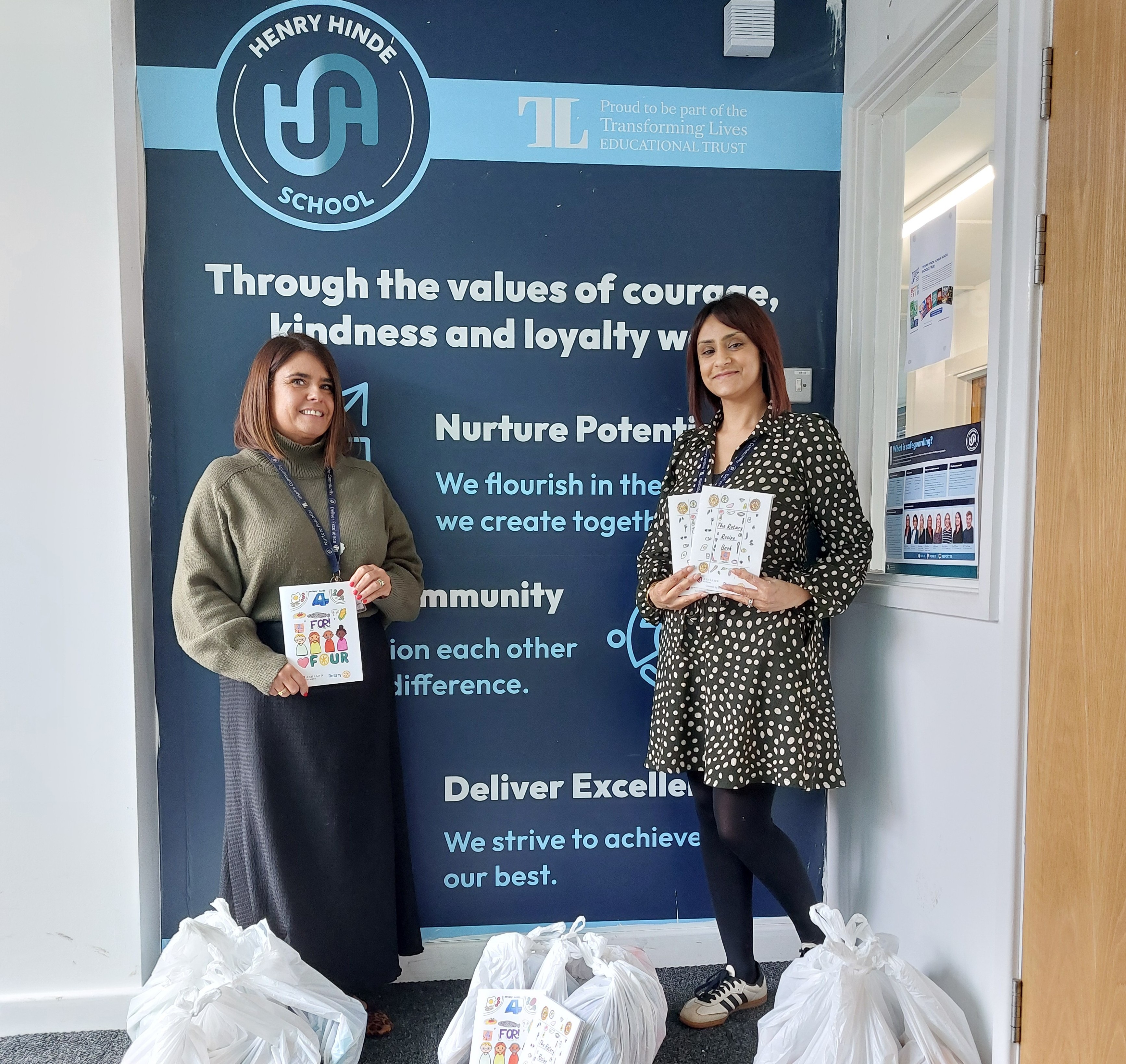
Last week they were collected and delivered to four schools by members of Rotary Club of Rugby – including Henry Hinde, Rugby Free School and St Oswalds CofE Academy – for further distribution to local families in need.

Rugby Rotary Club, schools, food parcels
Jodie Bradgate of Rugby Free School with Rotarian Richard Avery.

Tricia Davis, President of the Club, said: “Involvement in helping the community is an important part of the ethos of the school and it was heartwarming to see the enthusiasm with which the students greeted the challenge.

“These resources will ensure that families not only receive the ingredients but also the guidance needed to prepare affordable, healthy meals with confidence.

She added: “Food For Four is about more than providing food – it’s about education, empowerment and community collaboration. By working together we are not only supporting families in need but also giving students a valuable opportunity to contribute positively to their local community.

Rugby Rotary Club, schools, food parcels
Joanne Flaig and Mandeep Mann at Henry Hinde School.

“The initiative combines creativity, education and community spirit to provide practical support for families while engaging students in meaningful, real world learning. This joint venture reflects the strong partnership between Rugby Rotary Club and Ashlawn Schoo and highlights what can be achieved when education and community organisations work together for a shared purpose.”

The project followed a visit to the school earlier in the month by four Rotarians who also presented a certificate to two Year 7 students, Hannah Kirubakaran and Hanan Samuale, who designed the winning logo for the project.

Natasha Booth, Assistant Principal at Ashlawn School, said: “4 For Food is about more than providing food – it’s about providing education, empowerment and community collaboration. By working together, we are not only supporting families in need but also giving students a valuable opportunity to contribute positively to their local community.”

For more information about the Rotary Club of Rugby visit HERE.